Industrial Knife Manufacturer in India – Complete Guide for Modern Industries
Posted on
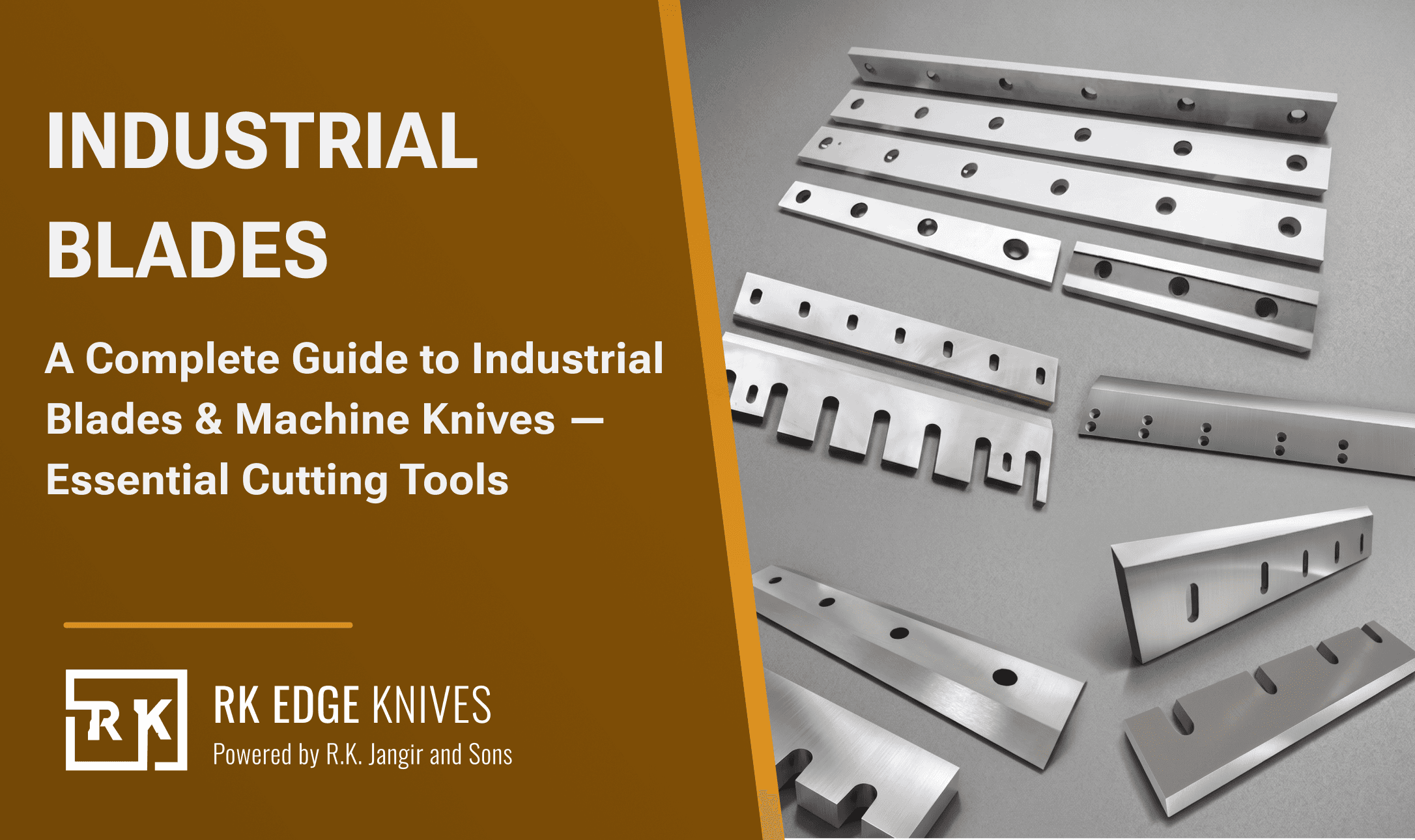
Industrial knives are the backbone of modern manufacturing — performing everything from precision cutting to heavy-duty shearing. Known by different names across industries — machine knives, industrial blades, cutting tools — these tools are built for one thing: clean, consistent, repeatable cuts. Whether you are processing steel, converting packaging film, recycling plastic, or cutting food, industrial blades are present at some stage of your production line.
But what exactly are industrial knives? How do they differ from regular blades? And what makes one knife right for a paper mill while another is engineered for a steel coil line?
In this blog, we'll cover:
What industrial knives are
The most common types and where they are used
Materials that make them durable and fit for purpose
And why precision manufacturing makes all the difference
At RK Edge, we manufacture precision industrial knives and blades engineered for high performance, long service life, and consistent cutting quality for demanding industrial applications.
What Are Industrial Knives?
Understanding the Importance of Industrial Machine Knives
Industrial blades are precision tools engineered for heavy-duty material processing. They are used across manufacturing, recycling, and packaging to cleanly process raw materials and finished goods.
Industrial machine knives are purpose-built cutting tools engineered for automated production machinery. What separates them from ordinary blades is their ability to maintain precision, durability, and consistent performance across thousands of operating hours. They are produced using high-carbon steels, stainless steel, carbide, and specialised alloys — selected based on the cutting demands of each application.
These blades come in an extensive variety of forms — circular blades for rotary cutting, straight blades for guillotine-style cuts, and toothed profiles for perforating and scoring. Regardless of form, the defining quality of every industrial knife is repeatability: the ability to produce the same precise cut hundreds of thousands of times over. In high-volume manufacturing, that consistency is not a bonus, it is a necessity.
Industrial Knife Usages
Slitting — longitudinal cutting of coils, films, paper reels, and foils
Shearing — clean straight cuts through metal sheets, plates, and stacked materials
Trimming — finishing edges in packaging, textile, and converting lines
Scoring & Perforation — creating tear lines in labels, bags, and packaging films
Granulating — reducing plastic waste into uniform, reusable pellets
Shredding — breaking down rubber, scrap, plastic, and industrial waste
Chipping — converting logs and wood waste into uniform chips for pulp and biomass
Food Portioning — precision slicing, dicing, and portioning in food processing lines.
Industrial Blade Applications
Guillotine Blades
Massive, straight-edge blades used in downward-pressure machines to slice through large stacks of paper, rubber, foam, and sheet metal without heat damage.
Trimmer Blades
Smaller, highly manuvarable blades (straight, rotary, or serrated) used for trimming margins, cutting precise shapes, and finishing edges on paper, photos, and textiles.Corrugated paper knives
Cut and score heavy cardboard boxes during manufacturing.Cross cutting blade
Cut continuous sheets of paper or film horizontally.Shear Blades & Sheet Shearing Blades
Heavy-duty, high-impact blades used to cut, notch, or slit sheet metal, steel plates, and coils in industrial fabrication and automotive plants.Pendulum Shearing Blades
Found in specialised swing-beam/pendulum shears; they move in an arc to quickly cut thick steel plates and structural materials.Crusher Blades
Highly durable, hardened steel blades used in recycling facilities to break down bulk materials like cars, appliances, plastics, and concrete.Chipper blades
Chop logs and tree branches into small wood chips.Veneer peeling blades
Peel thin layers of wood from rotating logs.
Wood slicer peeling knives
Slice lumber into thin veneer sheets for furniture.Cross cutting blade
Cut continuous sheets of paper or film horizontally.
Shredder Blades
Commonly used in recycling plants for plastic, rubber, scrap, and waste processing.
Materials Used in Industrial Blade Manufacturing
Material | Key Properties | Best Suited For |
|---|---|---|
D2 Steel | High wear resistance, excellent edge retention | Slitter knives, shear blades |
D3 Steel | High carbon, excellent hardness | General cutting applications |
H13 Steel | Heat and thermal-shock resistant | High-temperature cutting |
HSS | Superior heat resistance, high hardness | High-speed machining |
Stainless Steel | Corrosion-resistant, food-safe | Food processing, wet environments |
Carbide | Extreme hardness, longest blade life | Abrasive materials, long runs |
Conclusion
Industrial knives are critical components in modern manufacturing. Choosing the right industrial knife manufacturer in India ensures higher productivity, reduced downtime, and superior cutting performance.
For premium industrial blades and customised cutting solutions, connect with RK Edge. With decades of expertise in precision engineering and metallurgy, we deliver high-performance industrial knives designed for durability, accuracy, and long service life. From paper and packaging to metal, wood, plastic, and recycling industries, our solutions are trusted by businesses across multiple sectors.
At RK Edge, we focus on quality craftsmanship, advanced heat treatment, and customer-specific manufacturing to help industries achieve smoother operations and consistent results. Whether you need standard machine knives or fully customised industrial blades, our team is committed to delivering reliable solutions tailored to your requirements.
Frequently Asked Questions
How do I draw Frames?
To draw a Frame, click on Layout in the Toolbar, then select Frame. Now, you can click and drag anywhere on the Canvas.
How do I add images?
To add an image, select any Frame, and either double-click on it, or go to the Fill property. In the Fill property, switch to the image icon. Here, you can upload images.
How do I add videos?
To add a video to your site, click the “Insert” button and navigate to the “Media” section. Then, drag and drop a video component onto the Canvas.
How do I add videos?
To add a video to your site, click the “Insert” button and navigate to the “Media” section. Then, drag and drop a video component onto the Canvas.