D2 vs D3 Industrial Blades – Choosing the Right Tool Steel for Industrial Blades
Posted on
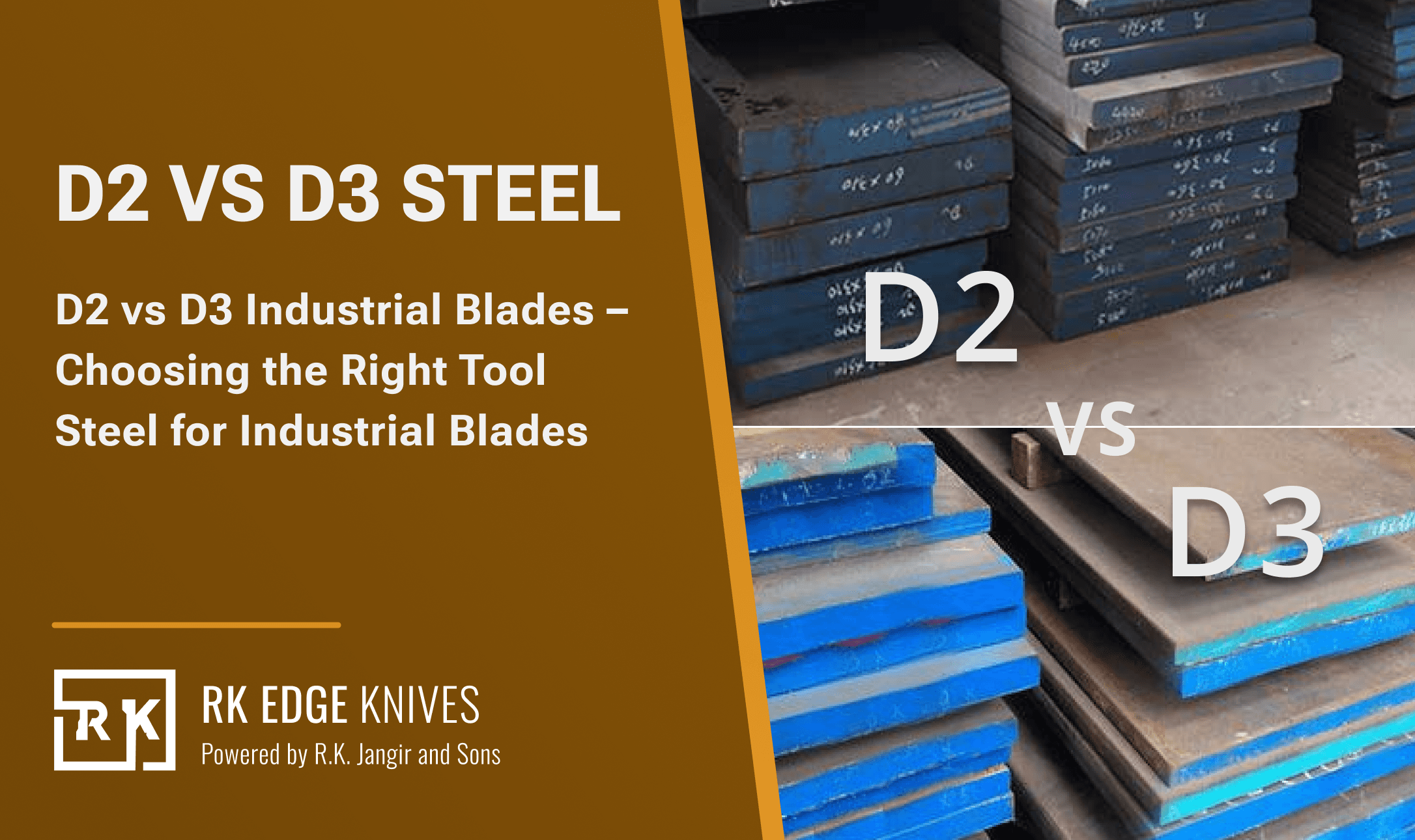
Every industrial blade operation eventually faces the same challenge — a shear blade chips under a sudden load spike, or a slitter knife wears down so fast it ruins cut tolerances. When choosing steel for cold-work blade applications, the decision often narrows down to two classic high-carbon, high-chromium grades: D2 and D3.
Evaluating D2 vs D3 is not about finding which steel is universally superior. It is about understanding how small shifts in chemistry completely change how a blade behaves under pressure. Picking the wrong grade guarantees frequent blade replacement, increased machine wear, and unexpected production downtime. This guide breaks down everything you need to know to make the right choice for your cutting application.
What Is HCHCR Steel?
Both D2 and D3 belong to the HCHCR — High Carbon High Chromium — family of cold work tool steels, engineered specifically for demanding tooling and cutting applications. Their defining characteristics include high hardness of up to 64 HRC, excellent wear resistance, good corrosion resistance, and superior dimensional stability — making them the preferred material family for industrial blades and knives where durability and cutting precision are non-negotiable.
What Is D2 Steel?
D2 is a high-carbon, high-chromium air-hardening cold work tool steel containing approximately 1.40%–1.60% carbon and 11.5%–13% chromium, along with vanadium and molybdenum. These additions significantly enhance toughness and dimensional stability during heat treatment, giving D2 its well-rounded performance profile.
With a hardness of around 60 HRC after proper heat treatment, D2 delivers an exceptional balance of wear resistance, hardness, and toughness — making it the most widely used steel for general-purpose industrial blades across a broad range of cutting applications.
Key properties of D2 steel:
High wear resistance through chromium carbide structure.
Better toughness and impact resistance than D3.
Excellent edge retention over long production cycles.
Easier to machine and regrind.
Moderate corrosion resistance — better than D3.
Better dimensional stability due to air-hardening process.
What Is D3 Steel?
D3 is also a high-carbon, high-chromium cold work tool steel but with significantly higher carbon content — 2.00% to 2.35% — and notably, without vanadium or molybdenum. This elevated carbon level produces a greater volume of hard carbides, delivering exceptional abrasive wear resistance and hardness levels of 63–65 HRC after heat treatment.
D3 is typically specified for blade applications involving minimal impact loads but demanding extreme wear resistance. However, its higher carbon content makes it considerably more brittle than D2, more difficult to machine, and best suited for dry, low-impact operating environments.
Key properties of D3 steel:
Superior abrasive wear resistance.
Higher ultimate hardness than D2.
Excellent edge retention in wear-intensive applications.
More brittle and prone to chipping under impact.
Lower corrosion resistance — best suited for dry environments.
Higher risk of distortion during heat treatment.
Chemical Composition — D2 vs D3
Element | D2 Steel | D3 Steel |
|---|---|---|
Carbon (C) | 1.40%–1.60% | 2.00%–2.30% |
Chromium (Cr) | 11.50%–13.00% | 11.50%–13.00% |
Vanadium (V) | ≤1.00% | — |
Molybdenum (Mo) | 0.70%–1.20% | — |
Silicon (Si) | ≤0.60% | ≤0.40% |
Manganese (Mn) | ≤0.60% | ≤0.40% |
The key distinction: D2 contains vanadium and molybdenum which significantly enhance strength and toughness. D3's higher carbon content delivers greater hardness and wear resistance but with reduced toughness at equivalent hardness levels.
D2 vs D3 — Performance Comparison
Property | D2 Steel | D3 Steel |
|---|---|---|
Carbon Content | 1.40%–1.60% | 2.00%–2.35% |
Hardness (HRC) | ~60 | 63–65 |
Wear Resistance | Excellent | Superior |
Toughness | Good | Moderate |
Impact Resistance | Better | Lower |
Machinability | Easier | Difficult |
Corrosion Resistance | Moderate | Lower |
Crack Resistance | Better | Lower |
Heat Treatment Risk | Low | Higher |
Cost Efficiency | More versatile, better value | Narrower scope |
Applications of D2 Steel Industrial Blades
D2 is the preferred choice for the majority of industrial blade applications due to its balanced performance under varied cutting conditions.
Shear & Slitter Blades — Used in metal fabrication and steel processing lines where blades regularly encounter impact and heavy loads.
Paper & Packaging Blades — Ideal for paper cutting, packaging knives, and textile blades requiring consistent edge retention and toughness.
Stamping & Forming Tools — Rolling mill blades, forming rolls, and cold work stamping tools widely used in automotive and aerospace sectors.
Chipper & Industrial Cutters — Wood chipper knives and heavy-duty industrial cutters where shock absorption is critical to blade longevity.
Applications of D3 Steel Industrial Blades
D3 is best suited for specialist blade applications where abrasive wear is the dominant concern and impact is kept to a minimum.
Precision Slitting & Blanking — Slitter knives and blanking dies where maximum hardness and edge retention are the primary requirements.
Plastic Recycling Blades — Granulator knives and recycling blades operating under continuous abrasive conditions with minimal shock loading.
Drawing & Forming Dies — Deep drawing inserts, bending dies, and aluminium extrusion punches in high-volume, low-impact environments.
Paper & Packaging Cutting — Guillotine and paper cutting blades in controlled environments where abrasive wear is the main failure mode.
When to Choose D2 vs D3 — Selection Guide
Condition | Recommended Grade | Reason |
|---|---|---|
High impact + wear requirements | D2 | Superior toughness reduces cracking risk |
Extreme wear + low impact | D3 | Higher hardness maximises wear performance |
Humid or mildly corrosive environments | D2 | Better corrosion resistance |
Dry environments + severe abrasion | D3 | Optimised for non-corrosive wear conditions |
Cost-sensitive, versatile applications | D2 | Broader application range, better value |
High-volume, long production runs | D3 | Enhanced wear resistance extends blade life |
Heat Treatment and Machinability
Both D2 and D3 respond well to heat treatment but require strictly controlled process parameters. D2's air-hardening nature minimises distortion, ensuring better dimensional stability. D3 carries a higher distortion risk and demands more precise temperature and quenching control.
Both grades machine well when annealed, but machining difficulty rises significantly after hardening — especially for D3. Professional heat treatment by an experienced industrial blade manufacturer is essential to achieving the full performance potential of either grade.
How Steel Selection Affects Blade Performance
Wrong steel selection has direct consequences — D3 in high-impact applications causes chipping and premature failure; D2 in extreme abrasion environments leads to faster edge wear and frequent regrinding. Correct selection combined with professional heat treatment delivers longer blade life, better cut quality, and lower maintenance costs.
Conclusion
Choosing between D2 and D3 comes down to one thing — matching the steel to your cutting conditions. D2 suits most industrial environments. D3 excels where abrasion dominates and impact is absent. Get this decision right and you reduce downtime, extend blade life, and lower operational costs.
Connect with RK Edge for expert guidance on industrial blade material selection and precision blade manufacturing.
Frequently Asked Questions
How do I draw Frames?
To draw a Frame, click on Layout in the Toolbar, then select Frame. Now, you can click and drag anywhere on the Canvas.
How do I add images?
To add an image, select any Frame, and either double-click on it, or go to the Fill property. In the Fill property, switch to the image icon. Here, you can upload images.
How do I add videos?
To add a video to your site, click the “Insert” button and navigate to the “Media” section. Then, drag and drop a video component onto the Canvas.
How do I add videos?
To add a video to your site, click the “Insert” button and navigate to the “Media” section. Then, drag and drop a video component onto the Canvas.