A Complete Guide to Precision Grinding, Regrinding & Sharpening Services
Posted on
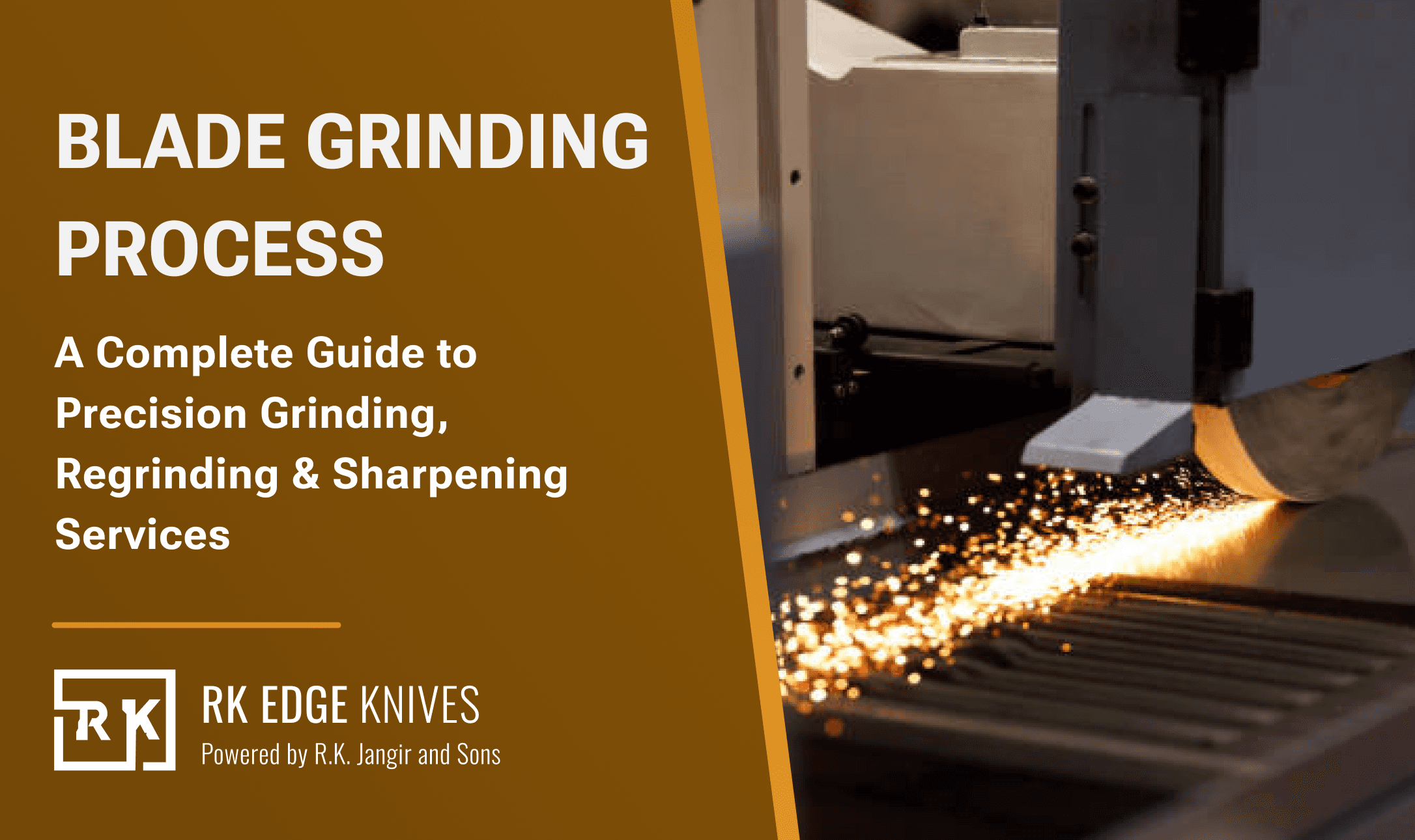
Industrial blades are critical components in manufacturing — from metal shearing and paper cutting to plastic recycling and packaging conversion. Under continuous use, blade edges wear down due to friction, heat, and abrasive materials, leading to poor cut quality, increased machine load, and costly downtime.
Precision blade regrinding restores cutting edges to factory-spec tolerances of up to ±0.01 mm using specialized CNC grinding machines — saving industries up to 80% compared to full blade replacement.
What Is Precision Grinding?
Precision grinding is a material removal process that uses abrasive wheels to achieve precise dimensions, tight tolerances, and superior surface finishes. In industrial blade maintenance, it restores blade sharpness, corrects edge geometry, and extends service life — making it an essential process wherever cutting accuracy and production consistency are non-negotiable.
Components of a Grinding Machine
Grinding Wheel — The primary cutting component made of abrasive grains. Common types include aluminum oxide for steel, silicon carbide for non-ferrous metals, CBN for high-speed steel, and diamond wheels for carbide-tipped blades.
Wheel Head — Houses and drives the grinding wheel at the required operating speed.
Work Table — Supports the blade and allows precise, controlled movement during grinding. Blades are mounted at the manufacturer's original bevel angle, typically between 10 and 35 degrees.
Coolant System — Delivers continuous cutting fluid to manage heat, prevent thermal distortion, and flush grinding debris.
Control Panel — On CNC machines, fully programmable for precise, repeatable grinding parameters.
Dresser — Resharpens and reshapes the grinding wheel to maintain consistent cutting geometry throughout the operation.
How Does the Grinding Process Work?
The grinding wheel's abrasive particles act as miniature cutting tools, each removing a tiny amount of material per pass. As the wheel traverses the blade repeatedly, worn and micro-fractured metal is stripped away until the original cutting geometry is restored.
Key parameters governing grinding quality include wheel speed, feed rate, grinding pressure, depth of cut, coolant flow, and machine rigidity. Proper control of all these variables is what separates professional precision grinding from basic sharpening.
Regrinding and Sharpening — What Is the Difference?
Sharpening is a lighter operation that restores a dull cutting edge with minimal material removal — suitable for blades with minor wear and no geometric distortion.
Regrinding is a comprehensive process removing 0.015" to 0.030" of material to eliminate subsurface micro-fractures, chipping, and dimensional deviation, restoring the full blade geometry to factory specifications.
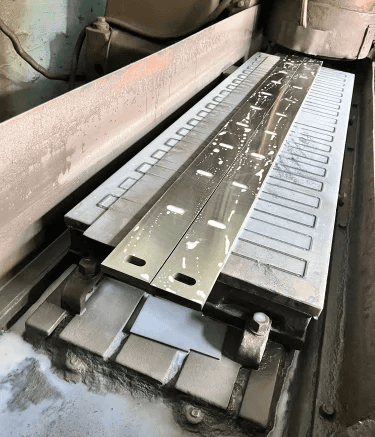
The correct service depends on blade material, extent of wear, machine type, and cutting application.
The Blade Grinding Process — Step by Step
Step 1 — Inspection and Cleaning: Blades are cleaned and inspected for micro-cracks, chipping, wear patterns, and dimensional deviation to determine the appropriate grinding approach.
Step 2 — Setup and Alignment: The blade is mounted at the manufacturer's exact original bevel angle. Accurate alignment at this stage is critical — any error carries through the entire process.
Step 3 — Surface Grinding: Restores flatness, parallelism, and dimensional accuracy, correcting any warping or geometric distortion from service.
Step 4 — Edge Grinding: High-speed abrasive wheels remove dull and micro-fractured metal in controlled rough and finish passes, restoring sharp, accurate cutting geometry.
Step 5 — Controlled Cooling: Continuous cutting fluids are flooded over the blade throughout grinding to prevent overheating, thermal distortion, burn marks, and hardness loss.
Step 6 — Deburring and Honing: The ground edge is polished to remove burrs, smooth the surface, and establish the correct edge topography for clean cutting.
Step 7 — Quality Control: Final edges are measured using optical comparators to verify tolerances before blades are oiled, packaged, and returned to service.
Types of Industrial Blades Serviced
Straight Blades — Guillotine blades, granulator knives, paper trimmers, and wood chipper blades.
Circular Blades — Slitter blades, rotary shears, and paper perforation knives.
Saw Blades — TCT circular saws, cold saws, and band saw blades.
Shear and Slitter Blades — Used in steel plants, coil processing, and sheet metal operations requiring precise edge accuracy and straightness.
Shredder and Granulator Blades — Subject to heavy wear in recycling applications, requiring frequent regrinding to maintain processing efficiency.
Factors Affecting Precision Finish and Accuracy
Machine Rigidity — Reduces vibration and ensures consistent dimensional results across the full blade length.
Wheel Selection — Matching the correct wheel type to the blade material is fundamental to achieving the right edge without overheating or chipping.
Coolant Use — Continuous coolant prevents overheating, maintains wheel performance, and ensures consistent quality.
Bevel Angle Accuracy — Incorrect mounting angles result in blades that cut poorly even after a complete regrind.
Operator Skill — Proper setup, wheel dressing, and process monitoring are integral to the quality of the final result.
Grinding Pressure — Optimized pressure ensures efficient material removal without compromising blade hardness or geometry.
Applications of Precision Blade Grinding
Blade grinding services are relied upon across steel plants, paper mills, plastic recycling facilities, packaging lines, woodworking operations, and automotive and aerospace manufacturing — wherever precision cutting tools are used under continuous industrial conditions.
Key Benefits of Professional Regrinding Services
Extended Tool Lifespan — HSS and carbide blades can be reground multiple times before reaching their usable limit.
Cost Savings Up to 80% — Regrinding is far more economical than frequent blade replacement.
Reduced Downtime — Scheduled regrinding programs minimize unplanned production stoppages.
Optimized Cut Quality — Factory-spec edge restoration improves cut accuracy, reduces dust generation, and lowers machine load.
Environmental Responsibility — Extending blade life reduces waste and conserves the resources required to manufacture new blades.
Conclusion
Precision blade grinding and regrinding is one of the most cost-effective maintenance practices in industrial manufacturing. It restores cutting performance, extends blade life, reduces machine wear, and lowers operational costs across every industry that depends on accurate, consistent cutting.
The quality of every cut begins with the condition of the blade — and the condition of the blade is maintained through precision grinding.
Frequently Asked Questions
How do I draw Frames?
To draw a Frame, click on Layout in the Toolbar, then select Frame. Now, you can click and drag anywhere on the Canvas.
How do I add images?
To add an image, select any Frame, and either double-click on it, or go to the Fill property. In the Fill property, switch to the image icon. Here, you can upload images.
How do I add videos?
To add a video to your site, click the “Insert” button and navigate to the “Media” section. Then, drag and drop a video component onto the Canvas.
How do I add videos?
To add a video to your site, click the “Insert” button and navigate to the “Media” section. Then, drag and drop a video component onto the Canvas.